Carbon, Carbon Dioxide and the Language of Climate
Understand carbon and carbon dioxide in climate claims, and identify the gases, boundaries and accounting choices behind a footprint before comparing it.
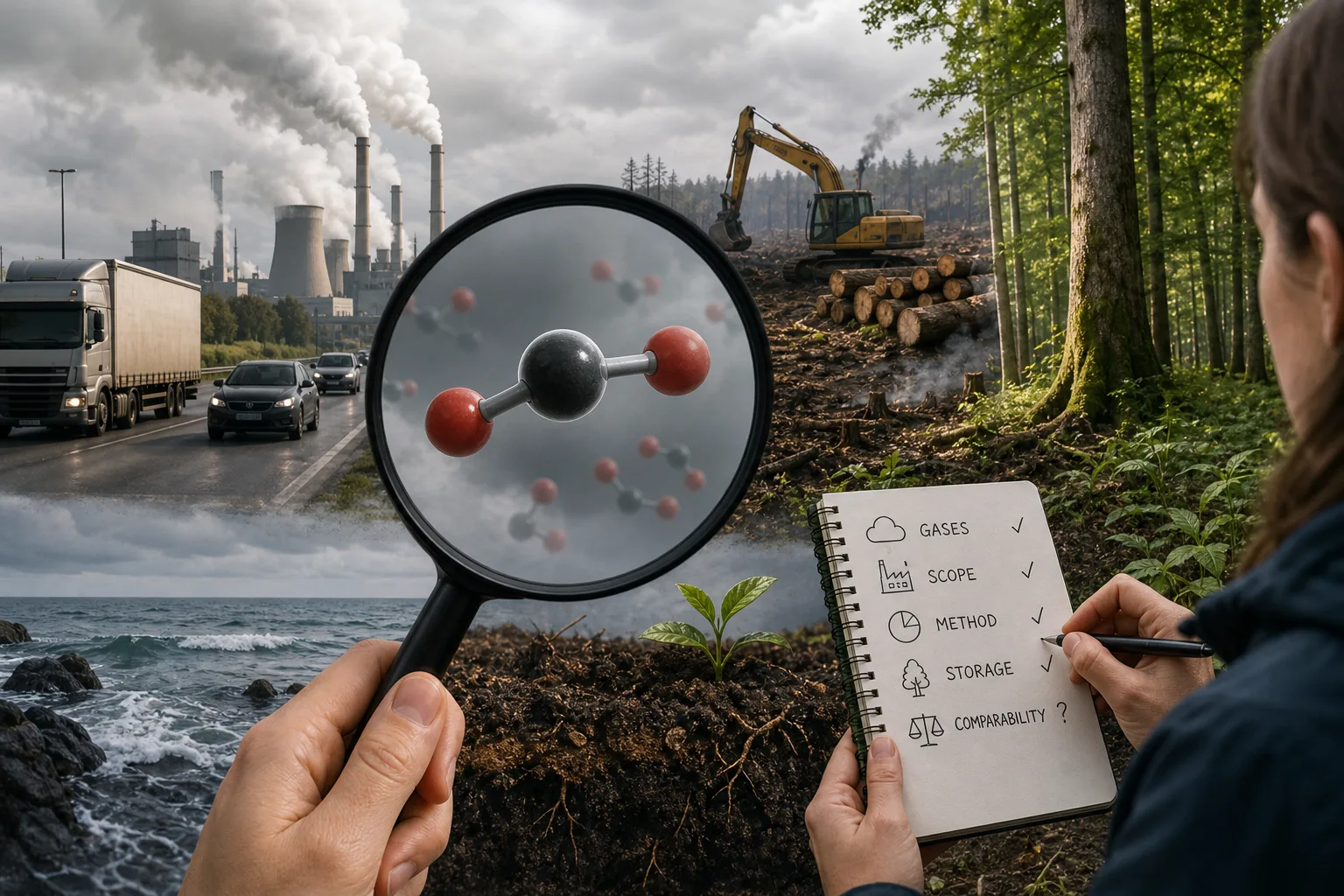
Carbon and carbon dioxide are not interchangeable terms, and that distinction matters when you read a carbon footprint. A claim may refer to one gas, several greenhouse gases, or a particular part of an activity’s emissions.
Carbon names an element, not a specific emission
Carbon is an element found in coal, oil, natural gas, wood, soil and living things. The word alone does not identify a gas or describe a particular climate effect.
In everyday climate language, “carbon” often stands for carbon dioxide emissions or a total covering several greenhouse gases. Look for wording such as “carbon dioxide”, “greenhouse gases” and “CO₂e” to see what a claim means.
If a statement says only “carbon”, ask what substance or total it refers to before comparing it with another claim.
Carbon dioxide is one greenhouse gas
Carbon dioxide, written as CO₂, consists of carbon and oxygen. It is a greenhouse gas that affects how heat moves through the atmosphere.
Burning fossil fuels releases carbon dioxide. Vegetation can release it when cleared or burned, while growing plants take it in; oceans and ecosystems exchange carbon with the atmosphere too. These flows have different sources and directions, so a natural exchange is not automatically equivalent to emissions from human activity.
“Carbon dioxide emissions” names a particular gas. “Carbon emissions” may refer to that gas alone or to a broader accounting total, depending on the writer’s definition.
A carbon footprint has a defined scope
A carbon footprint estimates greenhouse-gas emissions associated with an activity, product, organisation or person. Its boundary says which parts are counted: a product estimate might include materials and manufacturing, for example, while leaving use or disposal out.
CO₂e, or carbon dioxide equivalent, expresses different greenhouse gases on a common basis. It does not mean every gas in the total is carbon dioxide. The conversion uses a chosen accounting method and time horizon, and reporting frameworks may set out those choices differently.
A CO₂e figure is easier to interpret when its gases, scope and method are stated. Without those details, treat it as limited information rather than a sound basis for ranking claims.
Carbon-neutral wording describes an accounting approach
“Carbon neutral” does not mean that an activity produced no emissions. A claim may combine reductions at the source with credits or another balancing approach, and the accounting rules can vary.
Look for the emissions covered, the reductions made directly and the role assigned to credits or other balances. The label alone does not explain those details or establish that two claims use the same method.
Questions that clarify a carbon claim?
Does “carbon” mean carbon dioxide or several gases?
Look for a list of gases or a clear statement that several gases are reported as CO₂e. If neither appears, the wording does not establish which gases are covered.
What does a carbon footprint include?
Check the stated scope and its exclusions. If two footprints cover different activities or life-cycle stages, do not treat them as directly comparable.
What does a carbon-neutral claim balance?
Look for a description of source reductions and any credits or other balancing method. If it is missing, the phrase alone does not show what changed or how the balance was calculated.
How are different gases compared?
For a CO₂e total, check which accounting method and time horizon are stated. If the details differ or are missing, keep the totals separate rather than assuming they share a basis.
Emissions, removal and storage describe different things
Emissions are greenhouse gases released into the atmosphere. Carbon storage refers to carbon held in places such as forests, soils, geological formations or long-lived products; storage alone does not describe emissions that have been avoided.
Growing trees take in carbon dioxide and hold carbon in wood and other parts. If that material burns or decomposes, some carbon may return to the atmosphere. The duration and accounting treatment of storage matter when it is discussed alongside emissions.
For a removal claim, check what is removed, where it is stored and how possible later release is treated. Keep removal, storage and emissions reductions distinct.
Check these details before comparing claims
Use these checks to decide whether a comparison is fair or whether you need more information.
- Gases: If the claim names carbon dioxide or lists gases covered by a CO₂e total, record that wording; if it does neither, ask for the gas definition before comparing.
- Activities: If the claim names activities such as fuel use, electricity, transport or disposal, record them; if key activities are excluded or unclear, compare only with a claim covering the same activities or request clarification.
- Boundary: If the claim identifies a product, site, organisation or supply chain, keep that scope attached to the figure; if its boundary is vague, do not treat the figure as a whole-life or organisation-wide total.
- Claim type: If the statement describes a reduction, identify the emissions source; if it describes removal or storage, record that separately and ask how possible later release is handled.
- Reference: If a baseline or alternative is named, use it as the comparison point; if none is given, ask what “lower” means before drawing a conclusion.
- CO₂e method: If the method and time horizon are stated, record them; if either is missing, ask for the details or keep the figure apart from totals with a stated basis.
Imagine you are comparing two invented heating plans. Plan A says it will “cut carbon” but provides no scope. Plan B says it aims to reduce carbon dioxide from fuel use and excludes electricity and equipment. First, record Plan A’s gases and activities as unknown. Next, note that Plan B covers fuel-related carbon dioxide but excludes electricity and equipment. The decision is to ask for both plans to use a shared scope and comparable gas accounting; if that information is not supplied, keep the claims separate rather than ranking them.
Specific wording makes climate claims clearer
Use “carbon dioxide emissions” when a claim concerns that gas. Use “greenhouse-gas emissions expressed as CO₂e” when a stated method combines gases, and name the store when the claim concerns carbon held in a forest, soil or another place.
When you read a carbon footprint, check its gases, scope and accounting method before comparing it with another. Those details make the carbon claim easier to interpret and show where its account stops.