What a Material Passport Can and Cannot Tell You
A material passport can clarify what a product contains and how its parts fit together, helping you assess repair and reuse options while spotting gaps.
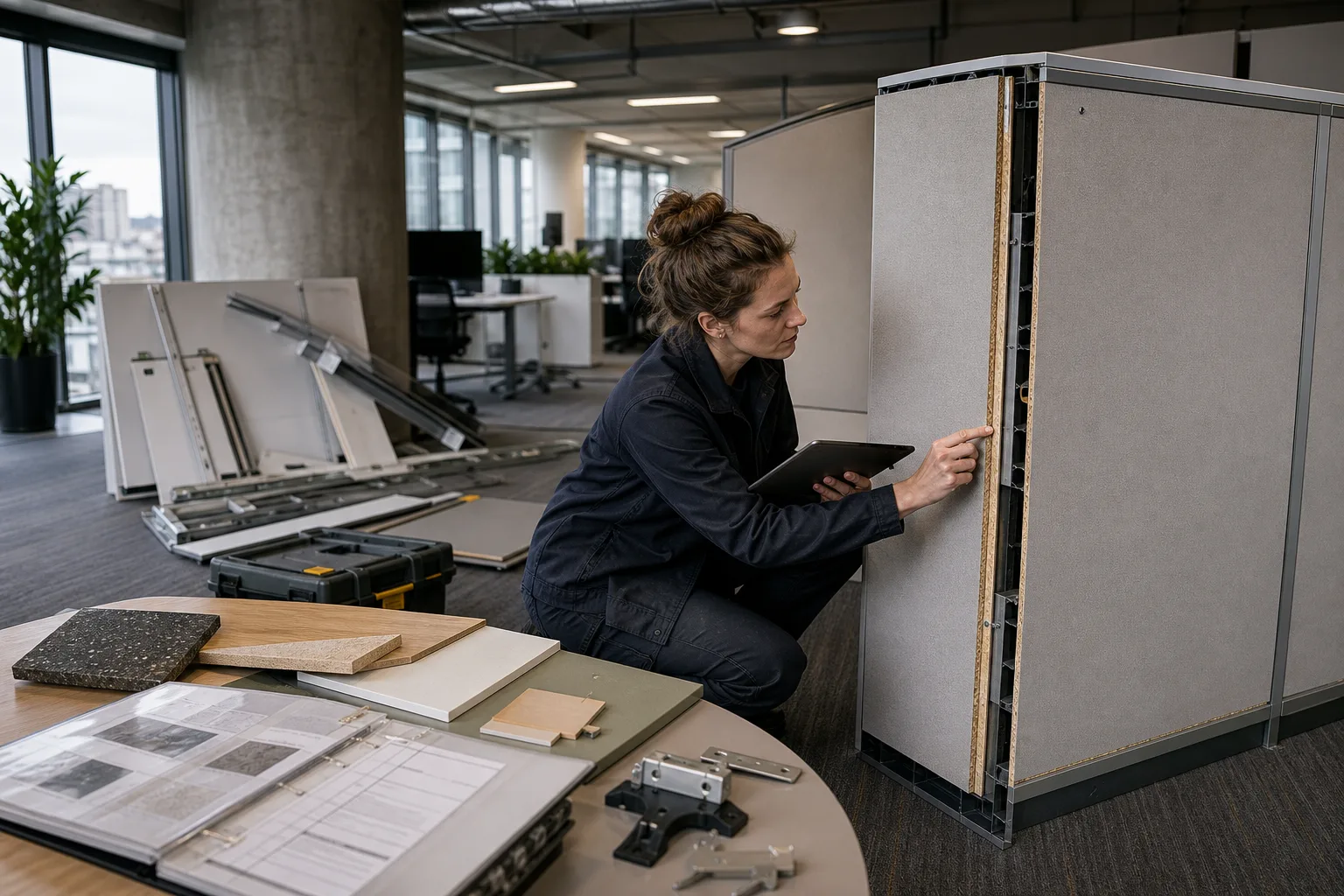
A material passport can help you decide whether a product is practical to repair or take apart, but it cannot by itself establish that the product has a low environmental impact. For office furniture, building panels or doors, the record is most useful when its material details match the item in front of you and answer the decision you need to make.
A material passport records information rather than awarding a verdict
A material passport is generally an organised record of materials and components associated with a product, asset or building. Depending on the scheme, it may support maintenance, repair, reuse, recovery or the management of materials at a later stage.
Its fields vary. A record may identify a component and its material, name a supplier, describe how parts are connected, or point to care and disassembly instructions. Some formats also include information about substances of concern, recycled content or material origin; check the scheme’s own definitions to see exactly what each field means.
The word “passport” can sound like an environmental certificate. Treat it instead as an information file: its value depends on what it covers, how its entries were gathered and whether the details are current.
Passports, declarations and assessments answer different questions
These documents can sit alongside one another, but they are not interchangeable. Their precise content depends on the applicable programme or reporting framework, so check the stated scope and rules rather than relying on a document’s title alone.
- A material passport is primarily organised around identifying and managing materials or components. It may help a repairer locate a part or help a project team plan disassembly, but the level of detail varies.
- An environmental product declaration (EPD) reports specified environmental information for a product under a stated programme and set of rules. Review its declared scope and indicators before using it to compare products.
- A life-cycle assessment (LCA) is a method for assessing potential environmental impacts across defined life-cycle stages and boundaries. It is not automatically a product passport or a public-facing declaration, though an EPD may draw on an LCA.
Say you are choosing between two office partitions for a refurbishment. One record says only “composite panel”; the other identifies the panel layers, joining method and supporting supplier documents. The second gives you specific questions to take to a contractor about separation and reuse, but neither record alone establishes the products’ relative environmental impacts.
Check what the record covers before relying on it
A passport may describe a component, a finished product or selected elements of a building. It may reflect the original specification rather than later repairs, substitutions or alterations, so compare it with the item as supplied or installed.
- Scope: If the record covers the whole product and its relevant components, use it for that product-level decision; if it covers selected parts only, ask for the missing entries before drawing a whole-product conclusion.
- Identity and version: If the model, revision or supplied item matches, proceed with the relevant check; if it does not, request an updated record or confirm the difference with the supplier.
- Material detail: If layers, coatings, adhesives or grades matter to your intended work and are specified, use those details to plan the next enquiry; if they are vague or absent, ask for clarification before planning separation or handling.
- Source and basis: If the record names who supplied the information and how it was checked, assess that basis for your purpose; if it does not, treat the entry as unverified and request supporting documentation.
- End-of-use route: If a named repairer, reuse organisation or processor confirms it can accept the component, plan around that route; if the record merely calls it recyclable, confirm local acceptance before assuming recovery is possible.
- Updates: If repairs and alterations are recorded, use the current version; if the record appears to describe the original product only, ask the owner or facilities team to confirm what has changed.
A blank field does not prove a material is harmful, and a completed field does not prove it is beneficial. Treat missing detail as uncertainty, especially when it affects safe handling, repair or a procurement requirement; for material-specific safety questions, seek guidance from a qualified professional.
Traceability is not a measure of environmental impact
Traceability can help identify a material’s source or follow information through a supply chain. That may make a supplier claim easier to check, but a traceable product can still have substantial impacts, while gaps in its records do not on their own reveal the full impact.
Environmental impacts can depend on extraction, processing, manufacturing, transport, use, maintenance and what happens after use. A passport may contain some related information, none of it, or a link to a separate assessment. Look at what the relevant document actually covers.
For a comparison, check whether the products’ EPDs or other assessments use compatible scopes, rules and indicators. If those differ, the documents may not support a like-for-like conclusion; ask the supplier or a qualified environmental practitioner to clarify the comparison.
Which material passport details matter for your decision?
What information should a material passport include?
Look for product identity, component and material descriptions, supplier details where relevant, and maintenance or disassembly instructions. Ask for the specific information your decision needs instead of treating a broad label as sufficient.
Does a material passport prove a product is sustainable?
No. It can make materials easier to identify and manage, but it does not automatically assess environmental impacts or compare products consistently. If your decision depends on an impact claim, request supporting evidence with a clear scope.
Is a material passport the same as an EPD?
No. A passport generally focuses on identifying and managing materials or components, while an EPD reports specified environmental information under its programme rules. Check each document’s scope and supporting material rather than relying on the label alone.
Who needs a detailed material passport?
Repairers, facilities teams, contractors and reuse organisations may need component and connection details to plan their work. A purchaser seeking only a broad composition overview may need less detail, provided that overview is enough for the decision at hand.
A worked example shows how a record can guide the next decision
Imagine a facilities manager has one office partition to remove and its passport lists three panels, two metal rails and one adhesive-bonded trim. The manager’s task is to decide whether to plan for intact reuse or ask a contractor about material separation; these quantities are invented starting inputs, not measurements of a real product.
The manager checks the record against the partition and confirms that the three panels and two rails match. The manager then checks the connection notes: the rails are described as mechanically fastened, while the trim is described as bonded, so the manager requests the named disassembly instructions for the rails and asks the supplier whether the trim can be removed without damaging the panels.
Next, the manager contacts a reuse organisation with the record’s panel and rail descriptions. If it confirms that it can accept all three panels and both rails in their current condition, the manager can plan for intact removal and reuse; if it accepts the rails but not the panels, the manager can plan to reuse the rails and ask a contractor about a separate route for the panels. If neither route is confirmed, the manager should not treat the passport’s material entries as proof that recovery will happen.
Choose evidence that fits the action you need to take
For a quick composition check, a basic material record may be enough. For repair or removal, seek part-level details and connection instructions; for an environmental comparison, look for suitable assessments and check that their scopes can be compared.
Use a material passport to make materials more legible and manageable, while keeping separate the questions it cannot settle on its own: whether a reuse route is available, whether an environmental claim is supported, and whether the recorded item still matches the product in service. Ask who will update the record after a repair or alteration, so the next person can make a decision from the item’s current details.