Why Recycling Symbols Need a Second Look
Recycling symbols identify packaging but cannot confirm local acceptance. Learn how to check each component and choose the right route for your collection service.
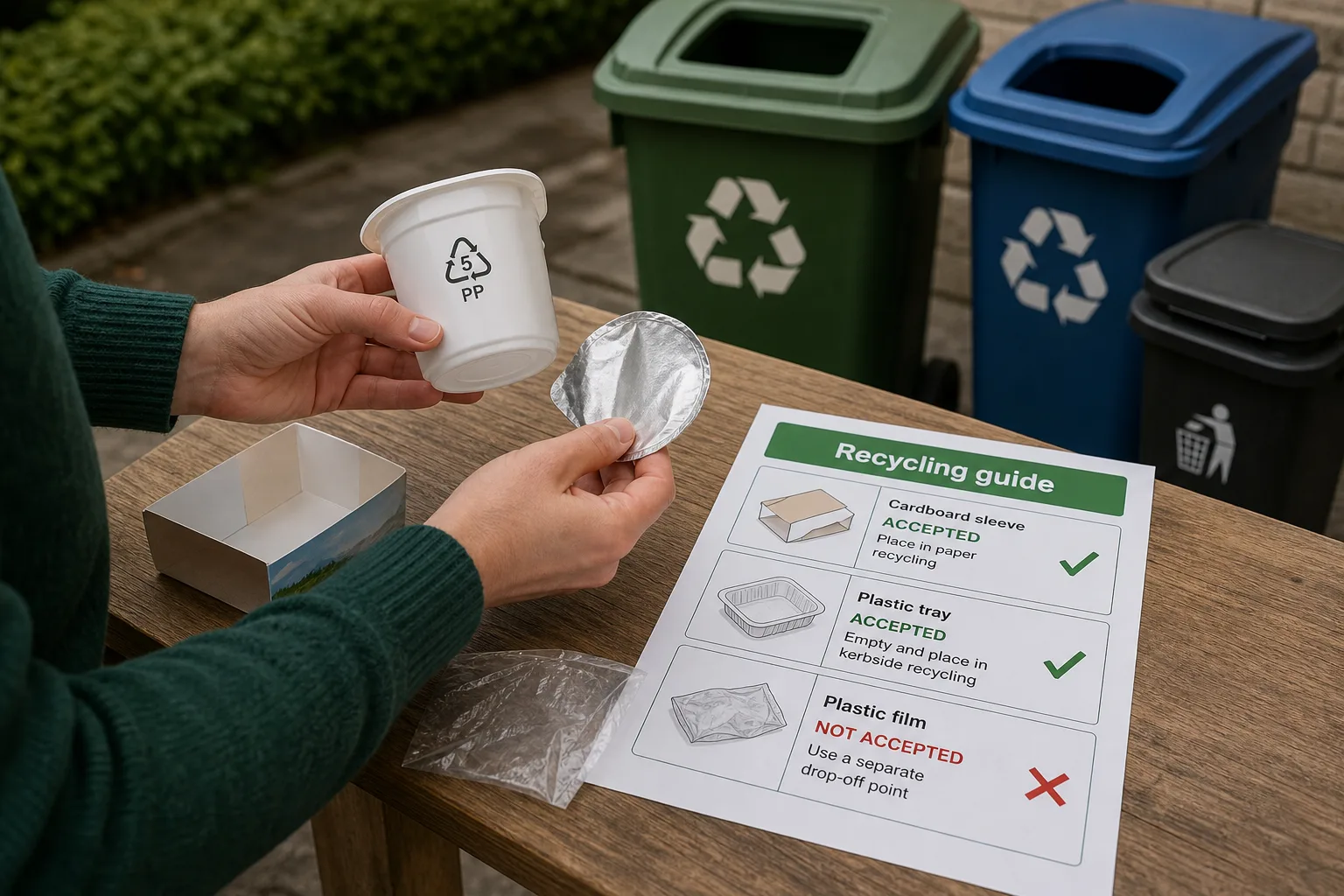
A plastic code on a yoghurt pot does not tell you whether your local service accepts it. Recycling symbols can identify packaging or signal market-specific arrangements, while the current collection guidance for your address determines the item’s route.
Start by identifying the exact package and its separate parts. Then use the collection service’s current instructions for the place where the waste will be collected.
Plastic codes identify resin, not collection routes
A number inside chasing arrows on plastic packaging identifies a resin type. It does not mean every council or recycling service accepts that particular package.
Shape and size can also affect the route. A rigid bottle, its cap and a flexible wrapper may receive different instructions, even if their material codes seem related.
Use a code to help identify the material, not to choose the bin.
The Green Dot depends on the market
The Green Dot is a pair of arrows forming a circular mark. Depending on the market, it may relate to a packaging recovery scheme or producer contributions; it is not a universal instruction that a local service will collect the package.
If you need to know what the mark means where the package is sold, consult information from the relevant market or packaging scheme. Treat collection guidance as a separate question.
Separate decisions for separate package parts
A food package might contain a cardboard sleeve, a plastic tray and a thin film. A symbol may refer to only one component, and each part may have a different route.
Imagine a package with those three parts. For this invented example, assume the local guide accepts the sleeve with card, accepts the emptied tray in kerbside recycling, and excludes the film while naming a separate alternative. Remove the sleeve and tray, empty the tray, sort them as instructed, and follow the stated route for the film. The result is a separate decision for each part, rather than one decision based on a single symbol.
Only separate lids, labels or films when the package or service instructions support doing so.
Check the exact item in the local guide
Search the current guidance for the address where the waste will be collected, using a specific description such as “rigid bottle” or “plastic film”. A guide may distinguish between items that look similar.
If the package directs you to a postcode- or country-specific checker, use the one for the relevant location. When general packaging wording conflicts with current local guidance, follow the service’s instruction for the exact item. If it does not resolve the question, contact the provider.
Before searching, identify the item’s form and any separate components.
Preparation rules are item-specific
An accepted package may need emptying, rinsing, flattening or separating. These are not universal requirements; follow them when the relevant service specifies them.
Check preparation notes alongside the accepted-items list. If the guide says to empty a tub or rinse it, follow that direction. Avoid extra washing or dismantling unless the instructions call for it.
What should you do when recycling symbols are unclear?
Does a number inside chasing arrows mean the package is recyclable?
Not by itself. On plastic packaging, the number identifies a resin type; the local guide determines whether that particular item is accepted by your collection.
Does the Green Dot mean my council will collect the package?
No universal collection instruction follows from the mark. Its meaning depends on the market, so check the relevant explanation separately from your local collection guidance.
Should I put an uncertain item in the recycling bin?
Look up the exact item in the current accepted-materials guide. If it is not listed, follow the service’s alternative disposal advice or ask the provider for clarification.
What if the package label and local guide disagree?
Follow the current instructions for the service collecting your waste when they address that exact item. If the guidance does not cover it or remains unclear, contact the service rather than treating a general package mark as proof of acceptance.
Use each observation to choose a route
- Observation: The guide lists the exact item and form as accepted. If/then decision: If it names a collection route, use that route; if it does not, follow the stated alternative or ask the service.
- Observation: The guide accepts one component but excludes another. If/then decision: If it directs you to separate them, sort each part as specified; if it gives a whole-package instruction, follow that instead, or ask if neither is clear.
- Observation: The guide requires emptying, rinsing or flattening. If/then decision: If it specifies a preparation action, do it before collection; if it does not, avoid adding an unsupported preparation step.
- Observation: The item is too small or flexible for the stated kerbside route. If/then decision: If the guide names a separate drop-off point, use it; if it does not, follow the listed alternative or ask the service.
- Observation: A symbol identifies a material, but the item is absent from the local list. If/then decision: If the guide gives an alternative, use it; if it does not, contact the provider before putting it in recycling.
- Observation: Package wording conflicts with the current local guide. If/then decision: If the guide addresses the exact item, follow it; if it does not, ask the collection service to resolve the uncertainty.
Say you have an invented yoghurt pot with one pot and one foil lid. The pot carries a plastic code; for this hypothetical, the local guide accepts rigid pots when emptied and directs foil lids to a named drop-off point. First, separate the lid from the pot. Next, empty the pot and place it in the specified kerbside bin. Then check whether the named drop-off point is available to you: if it is, take the lid there; if not, use the guide’s stated alternative or ask the service if none is given. The resulting decision is one kerbside route for the pot and a separate route for the lid.
For recycling symbols, keep material identification separate from collection rules. When you search for recycling symbols, check the exact item and each component in the current guide; the listed route, preparation instruction or alternative tells you what to do next.